From Entry-Level to Fractional: Why ASEAN-Linked Businesses Should Build in the Gulf
For ambiguous business explorers, the AI era has surfaced an uncomfortable truth: technology alone does not scale businesses. Ecosystems do.
Across Southeast Asia, companies are trimming senior roles while cutting junior positions amid AI-assisted execution. Meanwhile, across the Gulf, organisations are expanding, forming new entities, and actively seeking human capabilities that technology cannot replace: judgment, trust, human intelligence, relationship-building, and execution discipline.
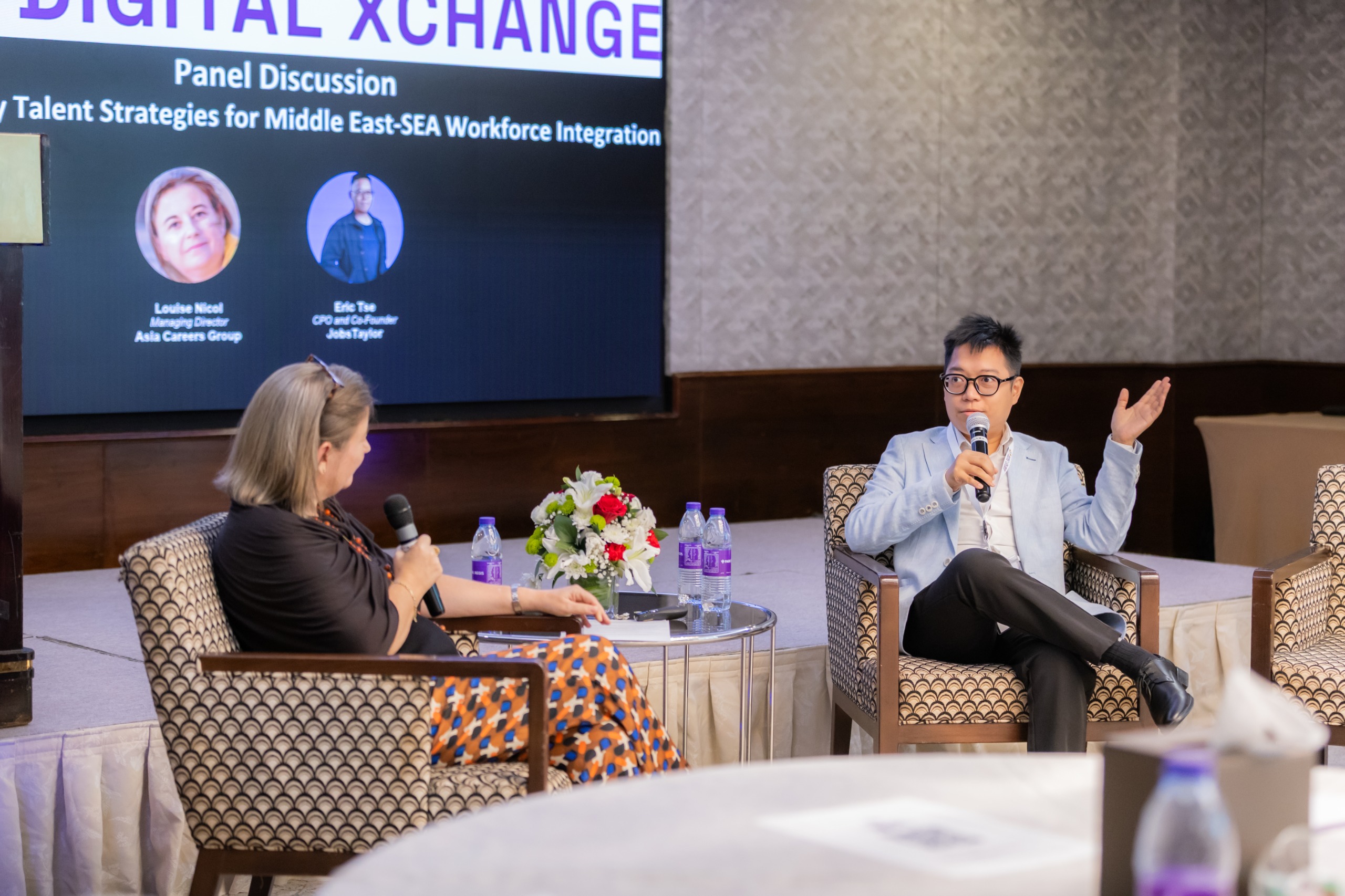
The strategic question for ASEAN-connected businesses is no longer whether to expand, but where to anchor growth. Increasingly, the answer may be the Gulf. This insight crystallised after I spoke as a panelist and moderator, and through interactions with the audience at the “APAC – Dubai Digital Xchange 2025” last November.
ASEAN Restructuring Meets Gulf Expansion
In ASEAN markets, restructuring has become structural. SMEs face rising costs, cautious capital, and compressed margins. Senior talent is available but underutilised. Junior talent is capable but bottlenecked by shrinking entry-level funnels.
The Gulf sits at the opposite point of the cycle. Governments across the region are actively incentivising:
- Company formation and relocation
- Cross-border partnerships
- Knowledge transfer and localisation
- Digital and AI-led transformation
For founders and C-suite leaders, this creates a rare alignment. Available ASEAN talent meets Gulf demand for execution and growth.
“Technology alone does not scale businesses. Ecosystems do. The strategic question for ASEAN-linked businesses is no longer whether to expand, but where to anchor growth.”
Fractional Leadership as a Cross-Border Growth Tool
One of the most effective bridges between regions is the fractional executive model.
Instead of relocating full corporate teams, SMEs can deploy:
- Fractional CMOs, CFOs, CTOs, or AI leads from ASEAN
- Supported by AI-enabled junior talent
- Operating across multiple Gulf-based entities or projects
This model reduces risk, preserves cash flow, and accelerates market entry, particularly for family offices and growth-stage SMEs testing the Gulf before committing to scale. The Gulf’s regulatory environment is notably receptive to flexible and agile arrangements, especially when compared to more rigid employment frameworks elsewhere.
Why the Gulf Values ASEAN Talent
Gulf businesses are not simply looking for affordable labour or technical skills. They value ASEAN professionals for deeper reasons:
- Strong operational discipline
- Cultural adaptability across East–Middle East contexts
- Long-term relationship orientation
- Willingness to work across ambiguity and evolving scopes
Experienced ASEAN professionals bring strategic oversight without corporate inertia. Younger ASEAN graduates bring hunger, resilience, and AI fluency, often at cost structures that remain viable for SMEs.
“The Gulf is not looking for cheaper labour. It is looking for judgment, adaptability, and execution under ambiguity.”
During the APAC – Dubai Digital Xchange 2025, the event also marked the kickoff of the Dubai chapter of the Asia AI Association (AAIA). Founded in Singapore and now active in the Philippines, Malaysia, and other ASEAN markets, AAIA supports enterprise AI adoption by driving practical AI integration that enhances efficiency, innovation, and decision-making. It connects AI professionals, academics, and industry leaders to foster collaboration, knowledge exchange, and responsible, ethical AI use across Asia.
AAIA recognises the human capital needs and opportunities emerging in the Gulf. Together, ASEAN-trained talent and Gulf-based enterprises form lean, high-trust teams aligned with the region’s growth mindset.
Policy, Geography, and the Power of Presence
The Gulf also offers structural advantages that matter to business builders:
- Strategic time-zone overlap with Asia, Europe, and Africa
- Pro-business regulatory frameworks
- Active government-led ecosystem building
- High concentration of capital, decision-makers, and partners
Perhaps the most overlooked advantage, however, is cultural. Business in the Gulf still runs on face-to-face engagement, shared meals, long conversations, and relationship continuity. Deals are accelerated not by cold outreach or automated funnels, but by presence, trust, and reputation. AI may prepare the materials, but humans close the loop.
Building in the Gulf, Not Just Selling to It
For ASEAN SMEs and founders, the opportunity is not merely to sell into the Gulf, but to build with it. By anchoring a base in the region, whether through partnerships, representative offices, or operating entities, businesses gain:
- Proximity to capital allocators
- Access to regional procurement and enterprise clients
- Faster trust-building cycles
- Visibility across adjacent markets
Bringing ASEAN talent into this environment compounds the advantage. Insights from Southeast Asia’s diverse markets inform Gulf expansion strategies, while Gulf scale and ambition unlock new growth paths.
Human-Centric Growth in an AI Age
As the Co-Founder of JobsTaylor, an AI career advisory platform, I often hear recruiters, university career coaches, and line managers describe their needs for new human capital. They are not only seeking talent that can master AI as a hard skill, but professionals who can also build and sustain relationships.
.jpeg)
As AI standardises outputs, relationships become the differentiator.
The Gulf market understands this instinctively. While AI accelerates operations, it does not replace:
- Trust built over time and face-to-face connections
- Judgment under uncertainty
- Accountability in high-stakes decisions
The Asia AI Association runs dedicated programmes across ASEAN that integrate Artificial Intelligence with Human Intelligence. These initiatives emphasise empathy, intuition, holistic thinking, and ethical judgment as capabilities machines cannot replicate. By strengthening human intelligence alongside AI skills, ASEAN professionals are better equipped to create culturally resonant solutions and translate technology into real strategic value.
For SMEs, startups, and family offices, ASEAN talent is increasingly prepared to expand into new regions. The Gulf, in turn, offers a growth environment where human collaboration and technological leverage coexist rather than compete.
A Strategic Repositioning for ASEAN Businesses
The future belongs to businesses that combine ASEAN’s depth of talent and execution, the Gulf’s capital, ambition, and connectivity, and AI as an enabler rather than a substitute for relationships.
For founders and executives willing to think beyond borders, the Gulf is not just a market. It is a platform. One built not on cold machines, but on shared growth, shared presence, and shared intent across the Gulf–ASEAN corridor.
—————
Eric Tse is the Co-Founder and Chief Product Officer of JobsTaylor, an AI-powered career advisory platform focused on helping professionals navigate work and career transitions in the AI era. He is an Executive Committee member of the Asia AI Association, where he supports enterprise AI adoption and ecosystem development across the region.
Eric is also a co-organiser of the Singapore Startup Community and a regular contributor to Lianhe Zaobao, where he writes on AI, technology, and their impact on work and society. In addition, he founded 1SeeThrough Consulting, a digital and AI build agency that helps organisations execute full-funnel digital transformation, from strategy and product development to implementation.