Political Risk Analysis in the Middle East: A 2026 Strategic Checklist

Navigating the Middle East's geopolitical landscape often feels like deciphering a complex code, where sensationalist headlines obscure the subtle shifts that truly impact capital and commerce. For leaders operating within the burgeoning Gulf-ASEAN corridor, a conventional approach to political risk analysis middle east is no longer sufficient, as it frequently fails to capture the human-centred drivers of policy and the nuanced regional contexts that determine success or failure. The constant information overload makes it profoundly difficult to connect high-level events to ground-level business operations, leaving strategic decisions vulnerable to incomplete narratives.
This 2026 strategic checklist is engineered to move beyond that noise. It offers a clear, actionable framework for evaluating regional shifts and provides tangible indicators for ensuring business continuity. By adopting a human-centred lens, we will equip you with the nuanced understanding required to not only mitigate emerging risks but to strategically identify and seize the opportunities unfolding between these two dynamic regions. Prepare to master the complexities and gain a decisive analytical edge.
Decoding Political Risk Analysis in the Middle East for 2026
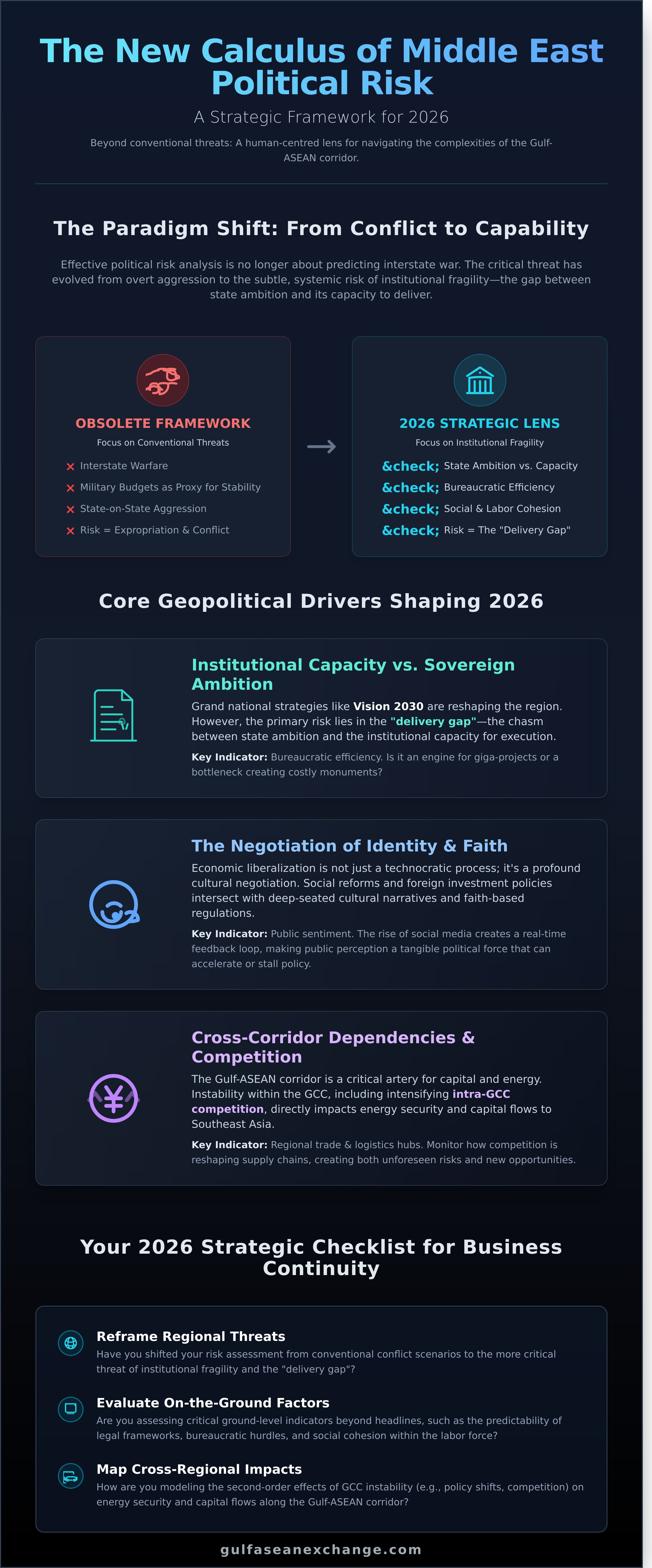
As the global community looks towards 2026, the framework for effective political risk analysis middle east is undergoing a profound transformation. The conventional lens, which equated regional instability with the probability of conventional warfare, is now dangerously obsolete. In this new era, the traditional definition of political risk-encompassing expropriation, conflict, and currency inconvertibility-fails to capture the more nuanced threats to capital and commerce. The primary challenge is shifting from overt interstate conflict to the subtler, yet more pervasive, issue of institutional fragility. We are moving from assessing state-on-state aggression to evaluating the internal capacity of nations to deliver on their ambitious socio-economic promises, making human-centred metrics not just a preference, but a necessity for accurate forecasting.
Beyond Security: A Holistic View of Regional Stability
For decades, military strength was the default proxy for regional stability; however, in today's context, it is merely a lagging indicator of business safety. The rise of an "armed peace," where direct conflict is contained but deep-seated geopolitical tensions simmer, creates an environment of persistent uncertainty that deters long-term, patient capital. Investors must now look beyond defence budgets and instead evaluate the "shadow cabinet" phenomenon-the informal networks of influence that can either accelerate or derail official policy-which is a critical variable in states undergoing rapid transition.
Why 2026 Demands a New Analytical Framework
The strategic landscape of 2026 is being shaped by factors that demand a completely new analytical model. The collapse of traditional diplomatic windows, such as the framework envisioned by the JCPOA, means that tensions are managed through more volatile, ad-hoc channels. Simultaneously, intensifying intra-GCC competition is fundamentally reshaping regional trade and logistics hubs, creating both new opportunities and unforeseen risks for businesses built on the old order. This complex interplay of domestic and regional pressures requires a sharper focus on state capability. Political risk, in this new context, is best defined as the gap between state ambition and institutional capacity.
The Core Drivers of Middle Eastern Geopolitical Shifts
To accurately assess the region's trajectory, one must look beyond headline conflicts and oil price fluctuations. The core drivers of geopolitical shifts are now predominantly internal, stemming from a fundamental tension between ambitious, top-down national transformation agendas and deeply embedded historical social contracts. This dynamic is complicated by resource nationalism, demographic pressures, and the enduring influence of identity and faith on the regulatory environment, forming the new calculus for regional stability.
Institutional Fragility vs. Sovereign Wealth Ambition
The grand national strategies, from Saudi Arabia’s Vision 2030 to the UAE’s Centennial 2071, are predicated on rapid, state-led development. However, the most critical variable is the "delivery gap"-the chasm between sovereign ambition and the institutional capacity for execution. Consequently, effective political risk analysis middle east now prioritizes bureaucratic efficiency as a primary indicator, determining whether giga-projects become economic engines or costly monuments. Furthermore, the influence of non-state actors, from powerful merchant families to local tribal leaders, can significantly shape the operational reality within new economic zones, often subverting centralised policy directives.
The Role of Identity and Faith in Policy Execution
Economic liberalisation in the Middle East is not merely a technocratic process; it is a profound cultural negotiation. Policies promoting foreign investment or social reforms often intersect with deep-seated cultural narratives that can either accelerate or stall their implementation. Navigating faith-based policy shifts, particularly in areas like Islamic finance or social conduct regulations, requires a nuanced understanding that goes beyond economic data. As detailed in high-level Middle East geopolitical analysis, the rise of social media has also empowered grassroots sentiment, creating a real-time feedback loop that can challenge or affirm state directives, making public perception a tangible political force.
The Gulf-ASEAN Nexus: Cross-Regional Corridor Risks
The deepening economic integration between the Gulf Cooperation Council (GCC) and the Association of Southeast Asian Nations (ASEAN) has forged a powerful financial bridge, with sovereign capital from the Gulf fuelling infrastructure, technology, and energy projects across Southeast Asia. However, this inter-regional corridor is not immune to geopolitical tremors originating in either region. A sophisticated political risk analysis middle east must therefore extend its scope to assess how instability reverberates across this nexus, impacting everything from ASEAN’s energy security to the risk appetite of Gulf investors. The sensitivity of these cross-border flows to regional escalations reveals both the corridor's immense potential and its inherent fragilities.
Supply Chain Fragility in the Maritime Trade Routes
The strategic maritime choke points connecting the two regions, from the Red Sea's Bab el-Mandeb Strait to the Strait of Malacca, are primary vectors of risk. Recent disruptions stemming from high-stakes proxy competition have weaponized these routes, causing shipping insurance premiums to soar and forcing costly diversions around Africa. This directly impacts supply chain reliability for goods and energy moving eastward. In response, stakeholders are exploring alternative corridors, including land-based routes, though their viability remains a long-term prospect. Amid this uncertainty, key ASEAN nations are increasingly positioned as "neutral" commercial hubs, attracting Gulf-aligned capital seeking insulation from direct geopolitical fallout.
Capital Flows and Sovereign Investment Sensitivity
GCC sovereign wealth funds (SWFs), the primary engines of this financial bridge, are acutely sensitive to regional instability. During periods of heightened crisis, their calculus shifts from aggressive expansion to capital preservation, often leading to a re-evaluation of ASEAN portfolios, particularly in sectors like real estate and public markets. In this volatile context, financial centres like Singapore serve as a critical "safe harbor" for both capital and policy-makers seeking stability and regulatory certainty. The health of the Saudi-Singapore corridor, in particular, often acts as a real-time barometer for regional trust and the perceived stability of long-term investment horizons.
Ultimately, the resilience of the Gulf-ASEAN nexus hinges on the dual pillars of maritime and capital security. As events from the Red Sea to the South China Sea demonstrate, disruptions to physical trade routes have an immediate and chilling effect on cross-border investment confidence. For businesses and policymakers, a comprehensive political risk analysis of the Middle East is incomplete without mapping these cascading effects on their ASEAN interests.
Evaluating Local Governance and Regulatory Consistency
This requires a deep dive into the operational realities on the ground. Scrutinise the stability of regulations in freezones versus the mainland, identifying potential for regulatory arbitrage or sudden harmonisation. Key "red flags" include opaque local partnership requirements and a judicial system where commercial disputes lack a transparent, timely resolution process, signalling a higher risk of contractual breach.
Frequently Asked Questions on Political Risk in the Middle East
What are the primary political risks in the Middle East for 2026?
For 2026, key political risks centre on the execution of ambitious economic diversification agendas, such as Saudi Arabia's Vision 2030. Potential social friction from rapid reforms, uncertainty in leadership succession planning in several states, and persistent geopolitical flashpoints involving Iran and its proxies remain significant concerns. Businesses must monitor the delicate balance between domestic policy implementation and the ever-present potential for regional conflict escalation, which could disrupt commerce and capital flows.
How does political risk in the GCC differ from the Levant?
Political risk profiles diverge sharply across these sub-regions. In the Gulf Cooperation Council (GCC), risks are primarily economic and policy-driven, relating to succession, intra-GCC competition, and the sustainability of non-oil growth models. Conversely, the Levant (e.g., Lebanon, Jordan) faces more acute risks of state fragility, spillover from regional conflicts, the influence of non-state armed groups, and significant refugee-related pressures, making for a far more volatile operational environment.
Can insurance fully mitigate political risk for ASEAN businesses in the Gulf?
While Political Risk Insurance (PRI) is a critical tool, it does not offer complete mitigation. PRI can cover specific events like expropriation, political violence, or currency inconvertibility, providing a financial backstop for catastrophic losses. However, it cannot protect against more nuanced risks such as reputational damage, sudden regulatory changes that increase operational costs, or the indirect effects of sanctions on supply chains. It is one component of a broader risk management strategy.
What is the "human-centred" approach to political risk analysis?
A human-centred approach moves beyond purely quantitative metrics to analyse the motivations, relationships, and cultural contexts of key decision-makers and stakeholders. It prioritises qualitative intelligence, focusing on the "who" and "why" behind policy shifts and political events. This involves understanding leadership dynamics, societal sentiment, and informal power structures, which provides a more nuanced and predictive view of risk than economic data or credit ratings alone can offer.
How do Middle Eastern sovereign wealth funds respond to regional instability?
Sovereign wealth funds (SWFs) often act as strategic stabilisers during periods of instability. Domestically, they may be directed to increase investment in local projects to bolster economic confidence, as seen with Saudi Arabia’s PIF. Internationally, their strategy can be twofold: de-risking by reallocating capital to more stable markets or acting opportunistically to acquire undervalued assets. Their movements serve as a key barometer of state-level economic strategy and confidence.
Is Saudi Arabia safe for long-term ASEAN investment in 2026?
Saudi Arabia presents a landscape of profound opportunity balanced with calculated risk. The giga-projects linked to Vision 2030 offer immense potential, yet long-term stability hinges on the successful and sustained implementation of economic and social reforms. Investors must assess the pace of regulatory change, the potential for policy shifts, and regional geopolitical currents. Success requires a dynamic approach to political risk analysis middle east, adapting to the Kingdom's evolving commercial and political environment.
How do I monitor political risk without a dedicated in-house team?
Businesses without in-house analysts can effectively monitor risk by leveraging a portfolio of external resources. This includes subscribing to specialised intelligence services, engaging regional advisory firms for periodic briefings, and actively participating in business councils. Crucially, building a strong network of on-the-ground contacts-such as local legal counsel, partners, and industry peers-provides invaluable qualitative insights and early warnings that are essential for proactive risk management.
What is the impact of intra-GCC competition on regional business policy?
Intensifying competition, particularly between the UAE and Saudi Arabia, has become a powerful driver of pro-business policy reform. This rivalry accelerates advancements in areas like 100% foreign ownership, tax incentives, and residency rules to attract capital and talent. However, it can also create regulatory friction, as demonstrated by competing regional headquarters mandates. For ASEAN businesses, this dynamic presents both greater choice and the need for careful jurisdictional analysis.