
Southeast Asia Market Entry Strategy: A Forward-Looking Playbook for 2026

The strategic calculus for entering Southeast Asia is undergoing a profound transformation, rendering conventional playbooks increasingly obsolete. As the region navigates a complex nexus of digital acceleration, shifting geopolitical tectonics, and evolving regulatory frameworks, leaders and investors find their existing market knowledge tested against a future that is rapidly taking shape. For those charting a course into this dynamic landscape, formulating a successful southeast asia market entry strategy 2026 requires more than just updating existing models; it demands a fundamental re-evaluation of the region's trajectory and the very nature of opportunity within it.
This forward-looking analysis moves beyond the headlines to provide a resilient framework for sustained success. We will dissect the key economic, digital, and policy shifts that will define the ASEAN commercial corridor leading into 2026, identifying the high-growth sectors and markets that lie beyond the obvious choices. The objective is to equip you with the nuanced insights and strategic foresight necessary to not only anticipate change but to harness it, enabling you to make long-term capital allocation decisions with confidence and clarity.
The ASEAN Economic Landscape in 2026: Beyond the Growth Narrative
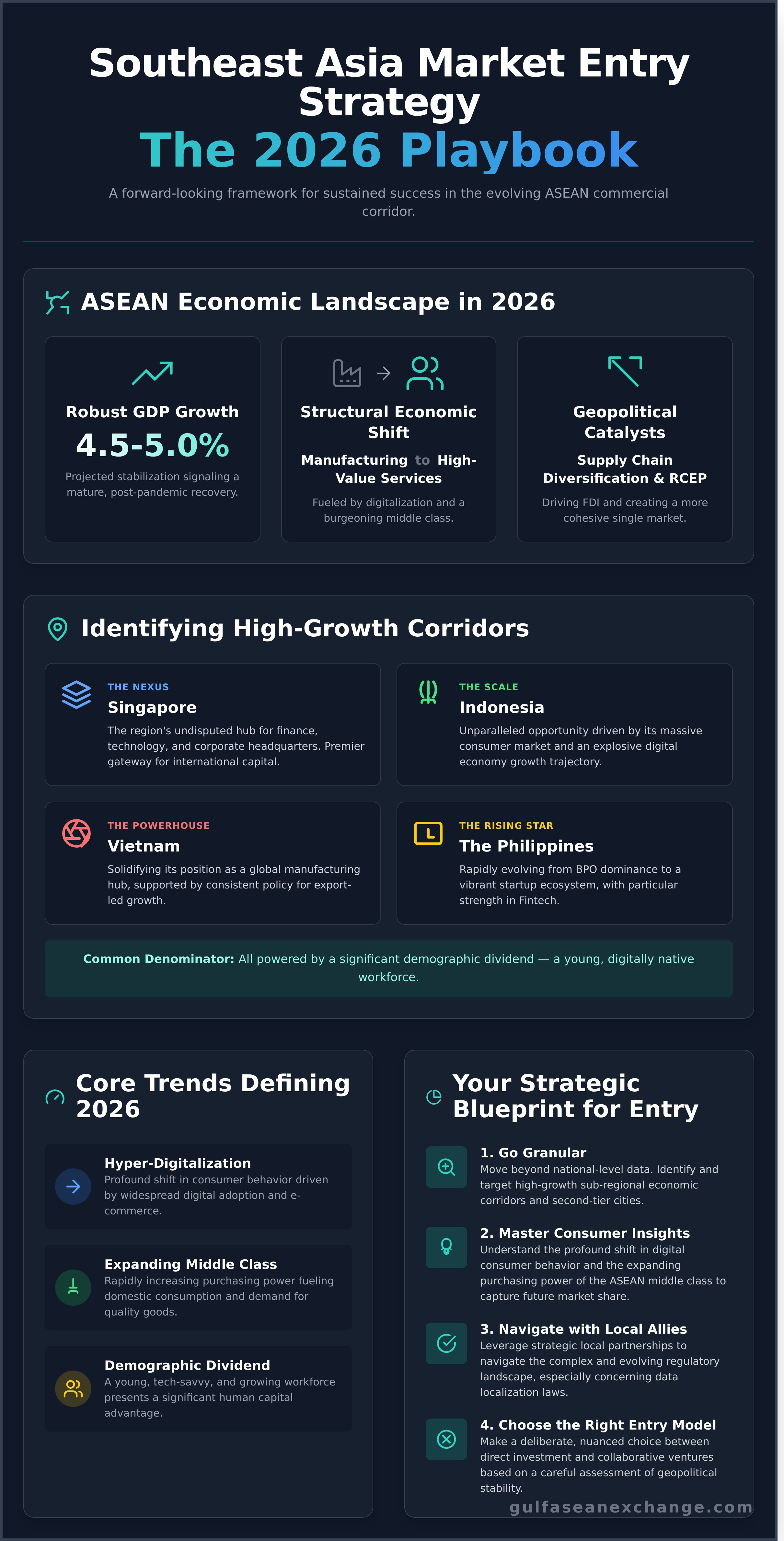
As we advance towards 2026, the narrative surrounding the Association of Southeast Asian Nations (ASEAN) has matured from one of simple, rapid growth to a more nuanced story of structural transformation and strategic realignment. While post-pandemic recovery remains robust, with regional GDP growth projected to stabilize around 4.5-5.0%, the underlying drivers of this expansion are evolving. A comprehensive understanding of the Economy of Southeast Asia reveals a decisive pivot from traditional manufacturing hubs towards sophisticated, high-value service economies. This transition, fueled by digitalization and a burgeoning middle class, is fundamental to crafting a successful southeast asia market entry strategy 2026.
This economic maturation is further accelerated by two significant geopolitical currents. Firstly, the ongoing diversification of global supply chains away from China continues to channel substantial foreign direct investment (FDI) into the region, positioning nations like Vietnam, Malaysia, and Indonesia as critical nodes in global commerce. Secondly, landmark trade agreements, particularly the Regional Comprehensive Economic Partnership (RCEP), are dismantling long-standing trade barriers, fostering unprecedented levels of regional integration and creating a more cohesive, predictable, and accessible single market for international businesses.
Macroeconomic Tailwinds and Headwinds
The primary engine of ASEAN's growth remains its vibrant domestic consumption, powered by a young, increasingly affluent population. However, this tailwind is tempered by the persistent headwind of inflation, which can erode consumer purchasing power and influence market sentiment. Simultaneously, ambitious, large-scale infrastructure development projects across the region-from transport corridors to digital infrastructure-are creating significant, long-term investment opportunities for firms in engineering, logistics, and technology.
Strategic Implications of the RCEP and CPTPP
For businesses, the strategic implications of agreements like the RCEP and the Comprehensive and Progressive Agreement for Trans-Pacific Partnership (CPTPP) are profound. These frameworks introduce simplified and harmonized rules of origin, significantly reducing the complexity and cost of cross-border trade within the bloc. This not only benefits goods producers but also unlocks new market access for service-based industries, including finance, telecommunications, and professional services, thereby attracting a new wave of specialised FDI into the region.
Identifying High-Growth Corridors: The Key Markets and Cities of 2026
An effective southeast asia market entry strategy 2026 requires a granular analysis that moves beyond national borders to focus on specific, high-potential economic corridors. Viewing the region as a monolith is a foundational error; success lies in identifying the dynamic city-clusters and specialised zones where commerce, capital, and talent converge. This nuanced geographic approach separates opportunistic plays from long-term, strategic investments.
The Established Hubs: Singapore and Indonesia
Singapore remains the region's undisputed nexus for finance, technology, and corporate governance, serving as the premier gateway for international capital and headquarters operations. In parallel, Indonesia presents an entirely different scale of opportunity, driven by its massive consumer market and a digital economy that continues its explosive growth trajectory. For businesses entering these mature markets, navigating their sophisticated, albeit complex, regulatory landscapes is a critical component of strategic planning.
The Rising Stars: Vietnam and the Philippines
Vietnam's position as a global manufacturing powerhouse continues to solidify, underpinned by consistent policy support for export-led growth. Concurrently, the Philippines is evolving rapidly from its traditional BPO dominance into a vibrant startup ecosystem, particularly in fintech. Both nations are buoyed by a significant demographic dividend: a young, digitally native workforce eager to adopt new technologies. This human capital is a key driver behind the optimistic ADB 2026 growth forecasts for the region, which project sustained economic expansion.
The Digital and Demographic Tsunami: Core Trends Defining 2026
Any successful southeast asia market entry strategy 2026 must be built upon a profound understanding of two converging forces: unprecedented digitalization and a powerful demographic evolution. These trends are not peripheral; they are the core currents shaping the region's commercial landscape, dictating consumer behaviour, operational realities, and the very definition of market acceptance. Navigating this environment requires more than a superficial acknowledgement of change; it demands a strategic realignment towards a digital-first, value-driven, and talent-centric approach.
Digitalization as the Default
The proliferation of digital platforms has moved beyond novelty to become the default mode of commerce and communication. The explosion in e-commerce, fintech solutions, and a vibrant creator economy has made mobile-first engagement a non-negotiable imperative. As projections for the ASEAN's digital economy continue to climb, leveraging sophisticated data analytics to execute hyper-local marketing campaigns becomes essential. This digital infrastructure is increasingly dominated by 'super-apps' like Grab, Gojek, and Sea, which serve as critical, all-in-one gateways to the consumer, influencing everything from logistics and payments to financial services.
Successfully tapping into this ecosystem requires more than just a presence; it demands a robust digital communication system designed for performance. This is where specialized partners can be invaluable. For example, The Palm Group is a digital agency that focuses on building these revenue-optimized systems, helping new entrants navigate the complexities of hyper-local digital marketing and consumer engagement.
Understanding the 2026 ASEAN Consumer
By 2026, the ASEAN consumer will be younger, more affluent, and ethically conscious, with Millennials and Gen Z constituting the majority of the workforce. This demographic demands more than just products; they seek brands that align with their values, prioritizing sustainability and transparent sourcing. Consequently, robust ESG (Environmental, Social, and Governance) principles are shifting from a corporate responsibility checkbox to a critical factor for brand loyalty. Influence is wielded through social commerce and trusted creators, making these authentic channels indispensable for building credibility and driving conversions.
Talent and the Future of Work
The operational side of a market entry strategy is also being fundamentally reshaped. The normalization of remote and hybrid work models has broadened the talent pool but also intensified competition for skilled professionals across the region. A critical challenge for new entrants will be addressing the digital skills gap. Success will depend on proactively forming strategic partnerships with local educational institutions and investing in robust internal training initiatives to build a resilient, future-ready workforce capable of navigating the complexities of the ASEAN market.
Navigating the Evolving Regulatory and Geopolitical Climate
While Southeast Asia presents a compelling economic narrative, its landscape is underpinned by a complex tapestry of regulations and geopolitical tensions that demand rigorous analysis. A successful southeast asia market entry strategy 2026 must move beyond commercial projections to incorporate a sophisticated understanding of non-market forces. The region is not a monolith; political stability varies significantly from the established predictability of Singapore to the dynamic electoral cycles in Indonesia and the Philippines, each carrying the potential for abrupt policy shifts.
The Regulatory Maze: Data, Privacy, and Localization
A defining trend is the rise of digital sovereignty, manifesting through stringent data governance. Frameworks like Singapore's and Thailand's Personal Data Protection Acts (PDPA) are now the standard, imposing significant compliance burdens. More critically, nations like Vietnam and Indonesia are enforcing data localization laws, which can necessitate in-country data centres, fundamentally altering IT architecture and operational costs. This digital maze is compounded by persistent foreign ownership restrictions in strategic sectors, often requiring joint ventures or other complex corporate structures to ensure legal market access.
Crafting Your 2026 Entry Playbook: Strategic Models for Future Success
Executing a successful market entry into Southeast Asia requires more than a generic template; it demands a bespoke playbook that reflects the region's dynamic commercial and geopolitical landscape. The optimal southeast asia market entry strategy 2026 is not a singular choice but a carefully calibrated decision based on your organization's risk appetite, capital allocation, and long-term ambitions. While Mergers & Acquisitions (M&A) can offer an accelerated path to market presence and infrastructure, they come with significant integration challenges. For most, the strategic calculus lies in balancing control with local agility, where collaborative models frequently outperform unilateral efforts.
The Critical Role of Local Partnerships
Beyond transactional joint ventures, deep-rooted local partnerships are the cornerstone of sustainable success in Southeast Asia. The process of identifying and vetting the right partner is a critical exercise in due diligence, extending beyond financial health to assess cultural alignment and shared strategic vision. Navigating business negotiations requires a profound appreciation for regional nuances-where indirect communication and relationship-building often precede contractual agreements. Ultimately, trust is not merely a component of the partnership; it is the fundamental currency upon which long-term commercial corridors are built.
Building a Resilient Go-to-Market Team
Your chosen entry model is only as effective as the team tasked with its execution. Assembling a resilient organization means hiring for adaptability and cross-cultural competence, prioritizing individuals who can navigate ambiguity and bridge communication gaps. Empowering local leadership with genuine autonomy for on-the-ground decision-making is not a concession but a strategic imperative, enabling the agility required to respond to market shifts in real-time. A culturally intelligent team is your most critical asset in transforming strategy into tangible market share.
Navigating the 2026 ASEAN Corridor: Your Strategic Imperative
The path to successful market entry in Southeast Asia by 2026 is paved not with outdated assumptions, but with a nuanced understanding of the region's dynamic interplay between digital acceleration and evolving geopolitical currents. Success will be defined by an agile approach that capitalizes on high-growth corridors while navigating complex local frameworks. Therefore, crafting a resilient southeast asia market entry strategy 2026 is less about a single point of entry and more about building a responsive, multi-jurisdictional presence.
Executing this playbook requires deep, localised intelligence. At Gulf-ASEAN Exchange, we bridge the gap between strategy and execution, providing the human-centred analysis and expert insights into policy, commerce, and capital flows that are critical for success. By engaging with our community of founders, operators, and policy-makers, you gain an unparalleled strategic advantage.
The opportunities emerging within the Gulf-ASEAN corridor are immense. With the right intelligence and network, your 2026 ambitions are not just possible-they are within reach.
Frequently Asked Questions: Navigating Your Southeast Asia Market Entry Strategy 2026
Which ASEAN country is the best to start with in 2026?
The optimal entry point into ASEAN is highly sector-dependent, not a one-size-fits-all determination. For financial services or a regional technology hub, Singapore remains the preeminent choice due to its robust legal framework and access to capital. However, for manufacturing and supply chain diversification, Vietnam presents a compelling case with its favourable labour dynamics. For businesses targeting a large, digitally-native consumer base, Indonesia’s demographic dividend is unparalleled. The critical first step is aligning country selection with core business objectives.
How will the growth of AI and automation impact market entry strategies for Southeast Asia?
The proliferation of AI and automation will fundamentally reshape market entry by enabling more sophisticated data analysis and operational efficiency. Companies can now leverage AI for granular market segmentation and predictive consumer behaviour modelling, crucial in a region as diverse as ASEAN. Operationally, automation in logistics and manufacturing, particularly in hubs like Thailand and Vietnam, allows for leaner initial setups and scalable supply chains, directly influencing capital expenditure models and competitive positioning from day one.
What are the most common pitfalls for foreign companies entering the ASEAN market?
A prevalent misstep is viewing ASEAN as a monolithic bloc rather than a heterogeneous collection of distinct markets, each with unique regulatory, cultural, and consumer landscapes. Another significant pitfall is underestimating the necessity of strong, well-vetted local partnerships for navigating bureaucratic intricacies and establishing trust. Finally, many firms fail to adequately resource for compliance and localization, leading to operational friction and a disconnect with the target consumer base, undermining an otherwise sound strategy.
Is it better to acquire a local company or build a new operation from scratch?
The decision between acquisition and a greenfield investment hinges on strategic priorities like speed, control, and risk tolerance. An acquisition can accelerate market entry by providing immediate access to licences, distribution networks, and local talent, but often involves complex integration challenges. Conversely, building from scratch affords complete control over corporate culture and operational standards but requires a more substantial investment in time and capital to navigate regulations and build a brand presence.
How can a Gulf-based company best leverage its unique position when expanding into ASEAN?
Gulf-based enterprises possess distinct advantages, primarily access to significant long-term capital and deep expertise in sectors like energy, infrastructure, and the Halal economy, which resonate strongly within key ASEAN markets like Indonesia and Malaysia. Leveraging burgeoning government-to-government economic partnerships can de-risk investment and open doors. A successful southeast asia market entry strategy 2026 for a Gulf firm should strategically align these capital and sectoral strengths with ASEAN's immense developmental and consumer growth trajectories.
What is the typical timeframe and investment required for a successful market entry?
A definitive timeline and budget are contingent on the sector, chosen market, and entry model. A tech or services firm might establish a functional presence within 12 to 18 months with an investment focused on talent and marketing. In contrast, a capital-intensive project like manufacturing could require a 3-to-5-year horizon and multi-million dollar investments. An effective southeast asia market entry strategy 2026 must be built on a foundation of patient capital and a long-term commitment.